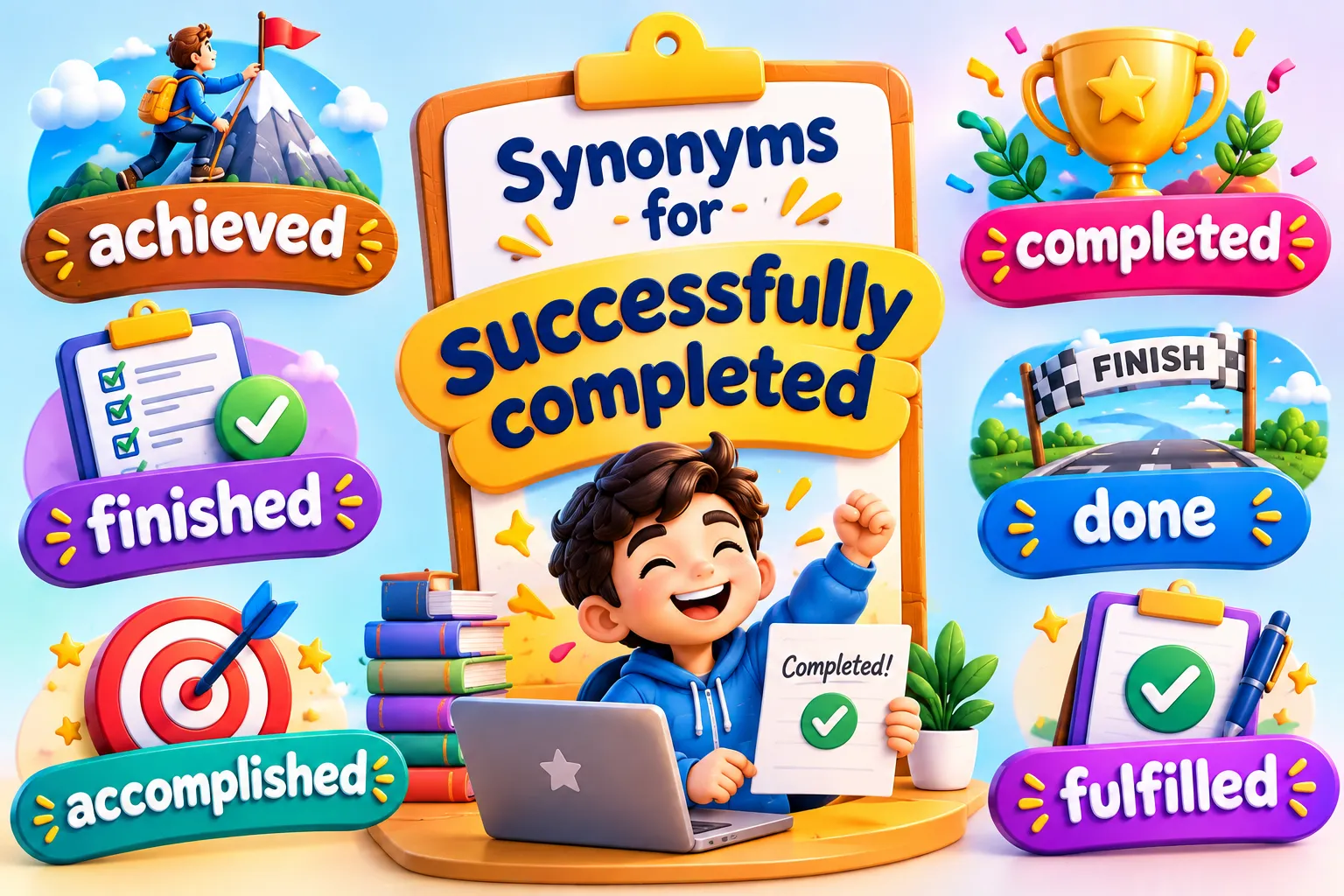
Useful synonyms include finished, accomplished, achieved, fulfilled, concluded, finalized, completed, executed, attained, realized, carried out, brought to completion, wrapped up, done, delivered, secured, obtained, reached, fulfilled, and concluded. The best choice depends on context. For example, a project may be completed, a goal achieved, a task accomplished, a plan executed, and a requirement fulfilled.
Successfully completed describes something that has been finished with the desired result. Imagine a student who submits a final project on time and receives approval from the teacher. The student has successfully completed the project. This phrase is common in school, work, business, project management, and everyday English because it clearly shows both completion and success. Learning synonyms helps English learners express ideas with more variety and precision. It also helps content writers avoid repeating the same phrase. However, not every synonym fits every situation. This guide explains the meaning of successfully completed, its grammar, pronunciation, word history, and related vocabulary. It also gives 30 useful alternatives with simple meanings and examples, followed by semantic categories and antonyms to help you choose the right word for each context.
Meaning of Successfully Completed
Definition
Successfully completed (adjective phrase): Finished something fully and achieved the intended result.
Examples
- She successfully completed her training course.
- The team successfully completed the project before the deadline.
Connotative Meaning
The phrase usually has a positive meaning because it suggests that an activity was finished and went well.
- Positive tone: Achievement, success, progress, and satisfaction.
- Negative tone: Usually none, but context can make it sound formal or overly official.
- Neutral tone: Simply states that something was finished successfully.
(Connotation: the feeling or idea that a word suggests beyond its basic meaning.)
Etymology
Because successfully completed is a phrase rather than a single word, its history comes from success, successful, and complete.
| Period | Development |
| Old English (450–1100) | The exact modern phrase did not exist. Ideas of finishing were expressed with Old English words related to bringing something to an end or fulfillment. |
| Middle English (1100–1500) | Complete entered English through Old French from Latin completus, meaning “filled up” or “finished.” Success developed from Latin successus, meaning “advance” or “good result.” |
| Modern English (1500–Present) | Successfully completed developed as a common phrase meaning that an action, task, or project was finished with the intended result. |
Pronunciation (IPA)
- IPA: /səkˈsesfəli kəmˈpliːtɪd/
- Syllables: suc-cess-ful-ly com-plet-ed
Affixation Pattern of Successfully Completed
Root
- Success: from Latin successus, related to succeeding or achieving a favorable result.
- Complete: from Latin completus, meaning “filled up” or “finished.”
Prefix
- Suc- / suc- is historically connected with the Latin prefix sub- in success.
- Com- in complete comes from Latin com- meaning “together” or “fully.”
Suffix
- -ful: forms successful from success.
- -ly: forms the adverb successfully.
- -ed: forms the past participle completed from complete.
Word Formations
- Success — noun
- Succeed — verb
- Successful — adjective
- Successfully — adverb
- Successfulness — noun
- Complete — verb/adjective
- Completed — adjective/past participle
- Completely — adverb
- Completion — noun
- Completeness — noun
30 Synonyms of Successfully Completed With Meaning & Examples
1. Accomplished (Verb/Adjective)
Meaning: Finished something successfully or achieved a desired result.
Examples:
- She accomplished the task before lunch.
- The team accomplished its main goal.
2. Achieved (Verb)
Meaning: Reached a goal or obtained a desired result.
Examples:
- He achieved his goal after months of work.
- The company achieved its sales target.
3. Finished (Verb/Adjective)
Meaning: Brought something to an end.
Examples:
- We finished the project yesterday.
- She has finished her assignment.
4. Completed (Verb/Adjective)
Meaning: Finished all parts of something.
Examples:
- They completed the course.
- The work was completed on time.
5. Fulfilled (Verb)
Meaning: Met a requirement, promise, goal, or expectation.
Examples:
- He fulfilled all the course requirements.
- The project fulfilled its main purpose.
6. Concluded (Verb)
Meaning: Brought an activity or event to an end.
Examples:
- The meeting concluded at noon.
- The investigation was concluded successfully.
7. Finalized (Verb)
Meaning: Finished the final details of something.
Examples:
- We finalized the report yesterday.
- The manager finalized the project plan.
8. Executed (Verb)
Meaning: Carried out a plan, task, or instruction successfully.
Examples:
- The team executed the plan perfectly.
- She executed the task according to the instructions.
9. Attained (Verb)
Meaning: Reached a goal, level, or result.
Examples:
- He attained his educational goal.
- The organization attained its target.
10. Realized (Verb)
Meaning: Made a plan, goal, or idea become real.
Examples:
- She realized her dream of becoming a teacher.
- The company realized its long-term plan.
11. Carried Out (Phrasal Verb)
Meaning: Performed or completed an action, plan, or task.
Examples:
- The workers carried out the instructions.
- The researchers carried out the study successfully.
12. Brought to Completion (Phrase)
Meaning: Finished something after completing all necessary steps.
Examples:
- The team brought the project to completion.
- She brought the assignment to completion before Friday.
13. Wrapped Up (Phrasal Verb)
Meaning: Finished an activity or task.
Examples:
- We wrapped up the meeting early.
- They wrapped up the project last week.
14. Done (Adjective)
Meaning: Finished or completed.
Examples:
- The work is done.
- I have done everything on the list.
15. Delivered (Verb)
Meaning: Completed and provided the expected result or work.
Examples:
- The agency delivered the project on time.
- The team delivered the promised results.
16. Secured (Verb)
Meaning: Successfully obtained or achieved something.
Examples:
- The team secured the required approval.
- She secured the contract after completing the proposal.
17. Obtained (Verb)
Meaning: Successfully got or acquired something.
Examples:
- He obtained the required certificate.
- The researcher obtained the necessary results.
18. Reached (Verb)
Meaning: Arrived at or achieved a particular goal or stage.
Examples:
- The company reached its annual target.
- She reached her goal after years of effort.
19. Realized Successfully (Phrase)
Meaning: Turned an intended idea or goal into reality.
Examples:
- The team realized the plan successfully.
- The project idea was successfully realized.
20. Fulfilled Successfully (Phrase)
Meaning: Met a requirement, promise, or objective in a successful way.
Examples:
- The applicant fulfilled the requirements successfully.
- The program successfully fulfilled its main objectives.
21. Accomplished Successfully (Phrase)
Meaning: Completed an important task with the desired result.
Examples:
- The mission was accomplished successfully.
- She accomplished the task successfully.
22. Brought to an End (Phrase)
Meaning: Finished an activity or process.
Examples:
- The project was brought to an end.
- They brought the discussion to an end.
23. Seen Through (Phrasal Verb)
Meaning: Continued with something until it was finished.
Examples:
- She saw the project through to the end.
- He saw the difficult task through successfully.
24. Pulled Off (Phrasal Verb)
Meaning: Managed to do something difficult successfully.
Examples:
- The team pulled off a difficult project.
- She pulled off the presentation successfully.
25. Mastered (Verb)
Meaning: Learned or performed something very well.
Examples:
- He mastered the new software.
- She mastered the skills needed for the job.
26. Overcame (Verb)
Meaning: Successfully dealt with a problem or difficulty.
Examples:
- They overcame every major challenge.
- She overcame the difficulties and finished the course.
27. Succeeded in (Phrase)
Meaning: Managed to do or achieve something.
Examples:
- He succeeded in completing the assignment.
- She succeeded in reaching her target.
28. Acquired (Verb)
Meaning: Successfully gained or obtained something.
Examples:
- He acquired the skills needed for the position.
- She acquired valuable experience during the course.
29. Fulfilled the Requirements (Phrase)
Meaning: Completed everything that was required.
Examples:
- The student fulfilled the requirements for graduation.
- The applicant fulfilled all the requirements.
30. Met the Goal (Phrase)
Meaning: Achieved the intended target or objective.
Examples:
- The team met its goal ahead of schedule.
- She met her goal after months of practice.
Prototype Meaning
The most typical meaning of successfully completed is finished something properly and achieved the expected result. When people hear this phrase, they usually imagine a task, project, course, assignment, or process that has reached its end without major problems. It focuses on both completion and success, not simply stopping an activity.
Prototype Categorization
- Completion-focused: finished, completed, concluded, wrapped up, brought to an end — useful when the main idea is that something has ended.
- Achievement-focused: achieved, attained, reached, realized, accomplished — useful when the result or goal matters most.
- Requirement-focused: fulfilled, fulfilled the requirements, met the goal — useful for rules, standards, duties, and objectives.
- Action-focused: executed, carried out, delivered, saw through — useful for projects, plans, instructions, and work.
- Informal expressions: done, wrapped up, pulled off — useful in casual conversations.
- Formal expressions: concluded, finalized, attained, fulfilled — useful in academic, professional, and business writing.
This categorization helps writers choose a synonym based on the exact idea they want to express instead of replacing every use with the same word.
Antonyms of Successfully Completed
| Antonym | Part of Speech | Meaning |
| Incomplete | Adjective | Not fully finished |
| Unfinished | Adjective | Not brought to an end |
| Failed | Adjective/Verb | Did not achieve the intended result |
| Abandoned | Adjective/Verb | Stopped before completion |
| Unfulfilled | Adjective | Not achieved or satisfied |
| Unaccomplished | Adjective | Not successfully achieved |
| Unfinished business | Noun phrase | Something that still needs attention |
| Pending | Adjective | Waiting to be completed or decided |
| Interrupted | Adjective | Stopped before completion |
| Unresolved | Adjective | Not settled or completed |
| Failed to complete | Verb phrase | Did not finish something |
| Neglected | Verb/Adjective | Failed to give something the needed attention |
Short Questions and Answers
What does successfully completed mean?
It means something was finished and achieved the expected or desired result.
When should successfully completed be used?
Use it when you want to show both that an activity ended and that it produced a successful result.
Is successfully completed positive or negative?
It is normally positive because it indicates successful achievement, although the wider context can affect the tone.
How is it different from similar words?
Completed mainly means finished, while successfully completed adds the idea that the desired result was achieved. Achieved focuses more on reaching a goal, while fulfilled often focuses on meeting a requirement, promise, or expectation.
Conclusion
Learning successfully completed and its synonyms can make your English more accurate and flexible. Words such as accomplished, achieved, fulfilled, finalized, concluded, executed, and finished can express similar ideas while highlighting different parts of an action. Some focus on finishing, while others focus on reaching a goal, meeting a requirement, or carrying out a plan. Understanding these small differences helps you choose better words for essays, emails, reports, conversations, and professional writing. Using synonyms also reduces repetition and makes your writing more natural. For English learners, regular vocabulary practice can build stronger speaking and writing skills. Try learning a few alternatives each day and use them in your own sentences. Over time, this simple habit can improve vocabulary, clarity, confidence, and overall English communication.
Read More:
25 Synonyms for Across to Improve Your Vocabulary

I’m Pinki, an SEO writer at SynonymsInstant.com, specializing in synonyms, antonyms, vocabulary, word meanings, grammar, and English usage. I create accurate, well-researched, reader-friendly content that combines language expertise with SEO best practices. My goal is to make English vocabulary simple, useful, and accessible for students, writers, professionals, and English learners.