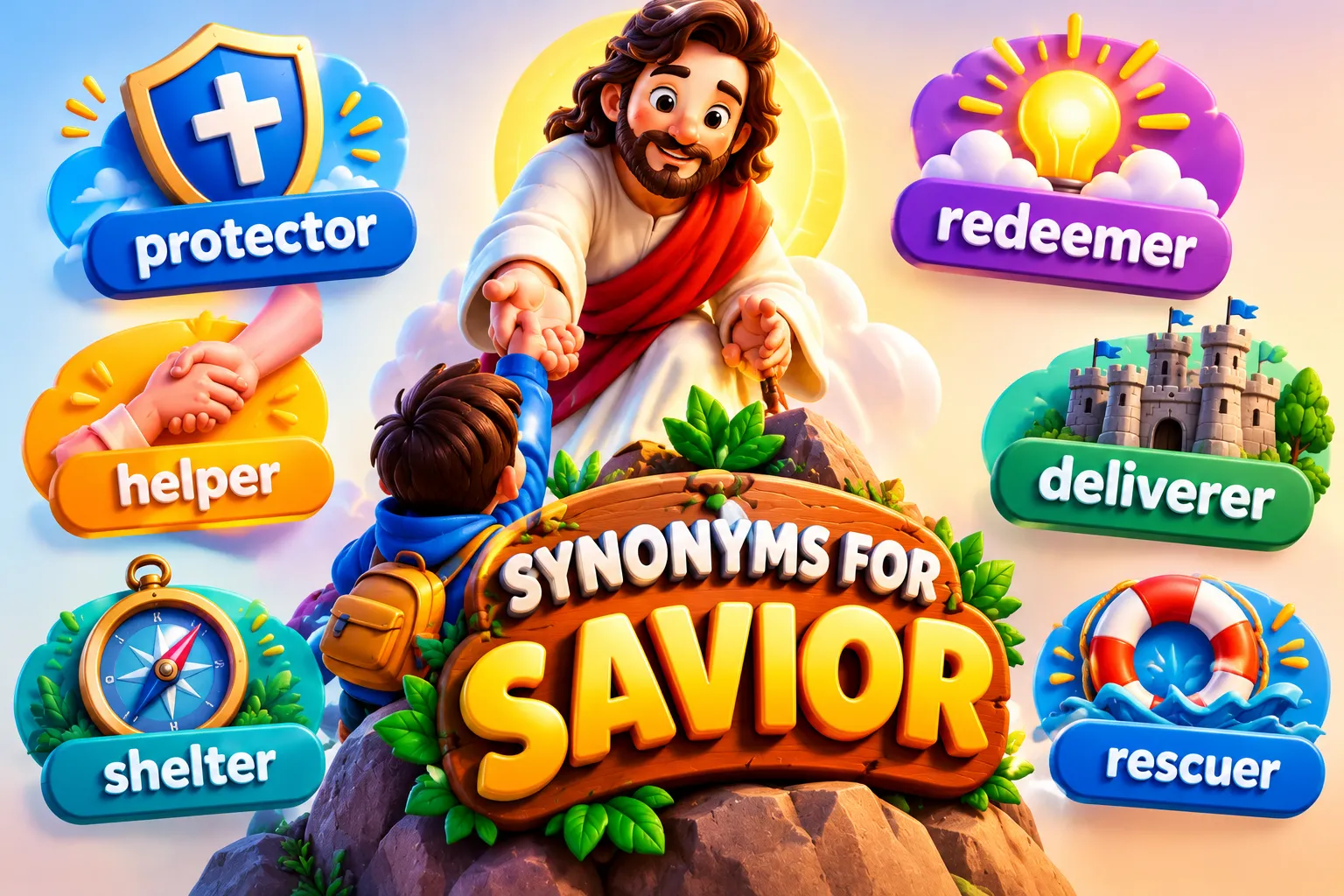
Depending on the context, useful synonyms include rescuer, deliverer, redeemer, liberator, protector, guardian, lifesaver, hero, champion, defender, and helper. Some words, such as redeemer and deliverer, have strong religious meanings, while others, such as rescuer and lifesaver, are common in everyday English.
Savior means someone who saves another person from danger, trouble, or harm. Imagine a child falling into a pool and a person quickly jumping in to save them. People may call that person a savior because they prevented a serious outcome. The word is common in everyday speech, stories, history, and religion. Learning synonyms for savior helps English learners choose words that fit different situations. It also helps writers avoid repeating the same word in articles, stories, and essays. However, not every synonym has exactly the same meaning or emotional tone. In this article, we explore the meaning of savior, its examples, grammar, history, pronunciation, word formation, and 27 useful synonyms. We also group these words into semantic categories and explain their differences so you can use them with greater confidence.
Meaning of Savior
Definition
Savior (Noun): A person who saves someone from danger, harm, failure, or a difficult situation.
Examples
- The firefighter became the savior of the family trapped inside the house.
- Many people saw the doctor as their savior during the crisis.
Connotative Meaning
- Positive tone: Savior usually suggests bravery, kindness, help, or hope.
- Negative tone: The word can sometimes sound exaggerated when someone is praised as a savior for a small action.
- Neutral tone: In a factual situation, it can simply describe someone who saves another person.
(Connotation: the feeling, idea, or emotion that a word suggests beyond its basic meaning.)
Etymology
The word savior ultimately comes from Latin salvātor, meaning “one who saves.” It entered English through Old French and Middle English forms related to save. The spelling saviour is especially common in British English, while savior is standard in American English.
| English Period | Development |
| Old English (450–1100) | English had related words for saving, such as hāl (“whole” or “safe”), but savior itself was not an Old English word. |
| Middle English (1100–1500) | Forms related to save, saviour, and salvour entered English through French and Latin influence. The religious sense became especially important. |
| Modern English (1500–Present) | Savior became an established noun meaning a person who saves. Saviour remains common in British English, while savior is common in American English. |
Pronunciation (IPA)
- IPA: /ˈseɪ.vjər/
- Syllables: sav-ior
- British variant: /ˈseɪ.vjə/
Affixation Pattern of Savior
- Root: sav- / save, connected with the idea of saving.
- Prefix: None in the modern word.
- Suffix: -ior, a noun-forming ending associated with a person who performs an action.
- Word formations:
- save — verb
- saved — verb/adjective
- saving — verb/noun/adjective
- saver — noun
- savior — noun
- salvation — noun
- salvage — verb/noun, historically related to the idea of saving or recovering
- salvific — adjective, meaning related to saving or salvation
27 Synonyms of Savior With Meaning & Examples
1. Rescuer (Noun)
Meaning: A person who saves someone from danger or difficulty.
Examples:
- The rescuer pulled the swimmer from the river.
- Everyone thanked the brave rescuer.
2. Deliverer (Noun)
Meaning: A person who frees someone from danger, suffering, or oppression.
Examples:
- The leader was remembered as a deliverer of his people.
- They believed the hero would be their deliverer.
3. Redeemer (Noun)
Meaning: A person who saves, frees, or restores someone from a serious problem.
Examples:
- The story presents the hero as a redeemer.
- He became a redeemer for people who had lost hope.
4. Liberator (Noun)
Meaning: A person who frees people from control, oppression, or captivity.
Examples:
- The general was praised as a liberator.
- The army was welcomed as a group of liberators.
5. Lifesaver (Noun)
Meaning: A person who saves someone’s life or provides vital help.
Examples:
- The nurse was a lifesaver during the emergency.
- Your advice was a real lifesaver.
6. Hero (Noun)
Meaning: A brave person who helps or saves others.
Examples:
- The firefighter became a local hero.
- She was called a hero after saving the child.
7. Protector (Noun)
Meaning: A person who keeps someone safe from harm.
Examples:
- The guard acted as a protector of the village.
- Parents often feel like protectors of their children.
8. Guardian (Noun)
Meaning: A person who protects or watches over someone.
Examples:
- The guardian kept the child safe.
- She became a trusted guardian of the family.
9. Defender (Noun)
Meaning: A person who protects someone from attack or harm.
Examples:
- The soldier was a defender of his country.
- He became a strong defender of the weak.
10. Champion (Noun)
Meaning: A person who strongly supports or protects a person, cause, or group.
Examples:
- She became a champion of children’s rights.
- He was a champion for people in need.
11. Benefactor (Noun)
Meaning: A person who gives help, money, or support to others.
Examples:
- A generous benefactor paid for the student’s education.
- The hospital received support from a wealthy benefactor.
12. Helper (Noun)
Meaning: A person who gives assistance to someone.
Examples:
- The volunteer was a great helper during the emergency.
- Every helper received thanks from the community.
13. Supporter (Noun)
Meaning: A person who provides help, encouragement, or support.
Examples:
- Her family was her strongest supporter.
- He became a supporter of the struggling community.
14. Savior-figure (Noun)
Meaning: A person presented as someone who can solve major problems or bring hope.
Examples:
- The new leader was seen as a savior-figure.
- The film creates a powerful savior-figure.
15. Good Samaritan (Noun)
Meaning: A helpful stranger who assists someone in trouble.
Examples:
- A Good Samaritan stopped to help the injured driver.
- A Good Samaritan gave the lost traveler directions.
16. Samaritan (Noun)
Meaning: A helpful person who assists someone in need.
Examples:
- A kind Samaritan helped the elderly man cross the street.
- The injured cyclist was assisted by a passing Samaritan.
17. Humanitarian (Noun)
Meaning: A person who works to improve human welfare and reduce suffering.
Examples:
- The humanitarian helped families affected by the disaster.
- She became a respected humanitarian.
18. Caregiver (Noun)
Meaning: A person who looks after someone who needs care or support.
Examples:
- His caregiver stayed with him throughout the illness.
- The caregiver helped the elderly woman every day.
19. Rescuer-at-heart (Noun)
Meaning: A person who naturally wants to protect and help others.
Examples:
- He is a rescuer-at-heart who always helps people in trouble.
- Her friends know her as a rescuer-at-heart.
20. Saviour (Noun)
Meaning: The British English spelling of savior, meaning a person who saves someone.
Examples:
- The firefighter was called a saviour by the family.
- Many stories describe a brave saviour arriving at the right moment.
21. Redeemer-figure (Noun)
Meaning: A person who represents rescue, restoration, or hope.
Examples:
- The novel portrays him as a redeemer-figure.
- The character becomes a redeemer-figure for the community.
22. Deliverer (Noun)
Meaning: A person who brings someone out of danger, suffering, or difficulty.
Examples:
- The people welcomed their deliverer with great joy.
- The hero became their deliverer during the crisis.
23. Rescuer (Noun)
Meaning: Someone who actively saves another person from danger.
Examples:
- The mountain rescuer reached the climber quickly.
- The rescuer carried the injured man to safety.
24. Savior of the day (Noun Phrase)
Meaning: A person who solves an urgent problem or prevents failure.
Examples:
- Maya was the savior of the day when the computer failed.
- Our driver was the savior of the day after the car broke down.
25. Problem-solver (Noun)
Meaning: A person who finds effective answers to difficult problems.
Examples:
- The engineer became the problem-solver during the crisis.
- We needed a good problem-solver for the project.
26. Ally (Noun)
Meaning: A person who supports and helps another person or group.
Examples:
- She became an important ally during the difficult period.
- The community found an ally in the local teacher.
27. Advocate (Noun)
Meaning: A person who publicly supports or protects a person, group, or cause.
Examples:
- He became an advocate for poor families.
- She is a strong advocate for children’s education.
Prototype Meaning
The most typical meaning of savior is a person who saves someone from serious danger, suffering, or trouble. When people hear the word, they often imagine a brave person arriving at an important moment to protect someone or bring them to safety. In religious contexts, the word can have a much deeper spiritual meaning and may refer to a divine or promised figure who brings salvation.
Prototype Categorization
- Physical rescue: rescuer, lifesaver, helper, savior of the day — these words work well when someone is saved from immediate danger or trouble.
- Protection and safety: protector, guardian, defender — these focus more on keeping someone safe than on one single rescue.
- Freedom and release: deliverer, liberator, redeemer — these words fit situations involving oppression, suffering, captivity, or restoration.
- Bravery and support: hero, champion, ally, supporter — these describe people who stand with others or provide important help.
- Care and service: caregiver, humanitarian, benefactor, Good Samaritan, Samaritan — these words highlight kindness, assistance, and service.
- Religious and spiritual use: Messiah, saviour, redeemer-figure, salvation-bringer, savior of souls — these terms are better suited to religious, spiritual, or symbolic contexts.
- Problem solving: problem-solver, advocate — these can describe someone who provides a solution or strongly supports people in difficulty.
This categorization helps writers choose the right word instead of treating every synonym as exactly interchangeable. It makes writing more precise and natural.
Antonyms of Savior
| Antonym | Part of Speech | Meaning |
| Endangerer | Noun | A person who puts others in danger. |
| Threat | Noun | A person or thing that may cause harm or danger. |
| Harm-doer | Noun | A person who causes harm to others. |
| Destroyer | Noun | A person or force that causes serious damage or destruction. |
| Persecutor | Noun | A person who treats another person cruelly or unfairly. |
| Oppressor | Noun | A person or group that controls others through harsh or unfair treatment. |
| Attacker | Noun | A person who deliberately tries to harm another person. |
| Abuser | Noun | A person who treats another person in a cruel or harmful way. |
Short Questions and Answers
What does savior mean?
Savior means a person who saves someone from danger, harm, trouble, or suffering.
When should savior be used?
Use savior when describing someone who saves another person or provides major help during a serious situation. It can also have a religious meaning.
Is the savior positive or negative?
Savior is usually positive because it suggests help, bravery, protection, and hope. However, it can sound exaggerated if used for a very small act of help.
How is it different from similar words?
Savior is a broad word for someone who saves. The rescuer usually focuses on physical rescue, the protector focuses on safety, the liberator focuses on freedom, and the redeemer often suggests restoration or spiritual rescue.
Conclusion
Learning savior and its synonyms can greatly improve your English vocabulary. Words such as rescuer, protector, hero, deliverer, and lifesaver help you describe people who provide help in different situations. Other words, such as redeemer and Messiah, are more suitable for religious or spiritual writing. Knowing these differences makes your writing clearer and more precise. Synonyms also help you avoid repeating the same word in essays, stories, articles, and conversations. For English learners, studying a word with its meaning, examples, pronunciation, history, and related words makes it easier to remember. Practice using one or two new synonyms each day. With regular practice, you can build stronger vocabulary, improve your speaking and writing, and become more confident in English.
Read More:
Synonyms for tranquil: 30 Peaceful Alternatives

I’m Pinki, an SEO writer at SynonymsInstant.com, specializing in synonyms, antonyms, vocabulary, word meanings, grammar, and English usage. I create accurate, well-researched, reader-friendly content that combines language expertise with SEO best practices. My goal is to make English vocabulary simple, useful, and accessible for students, writers, professionals, and English learners.