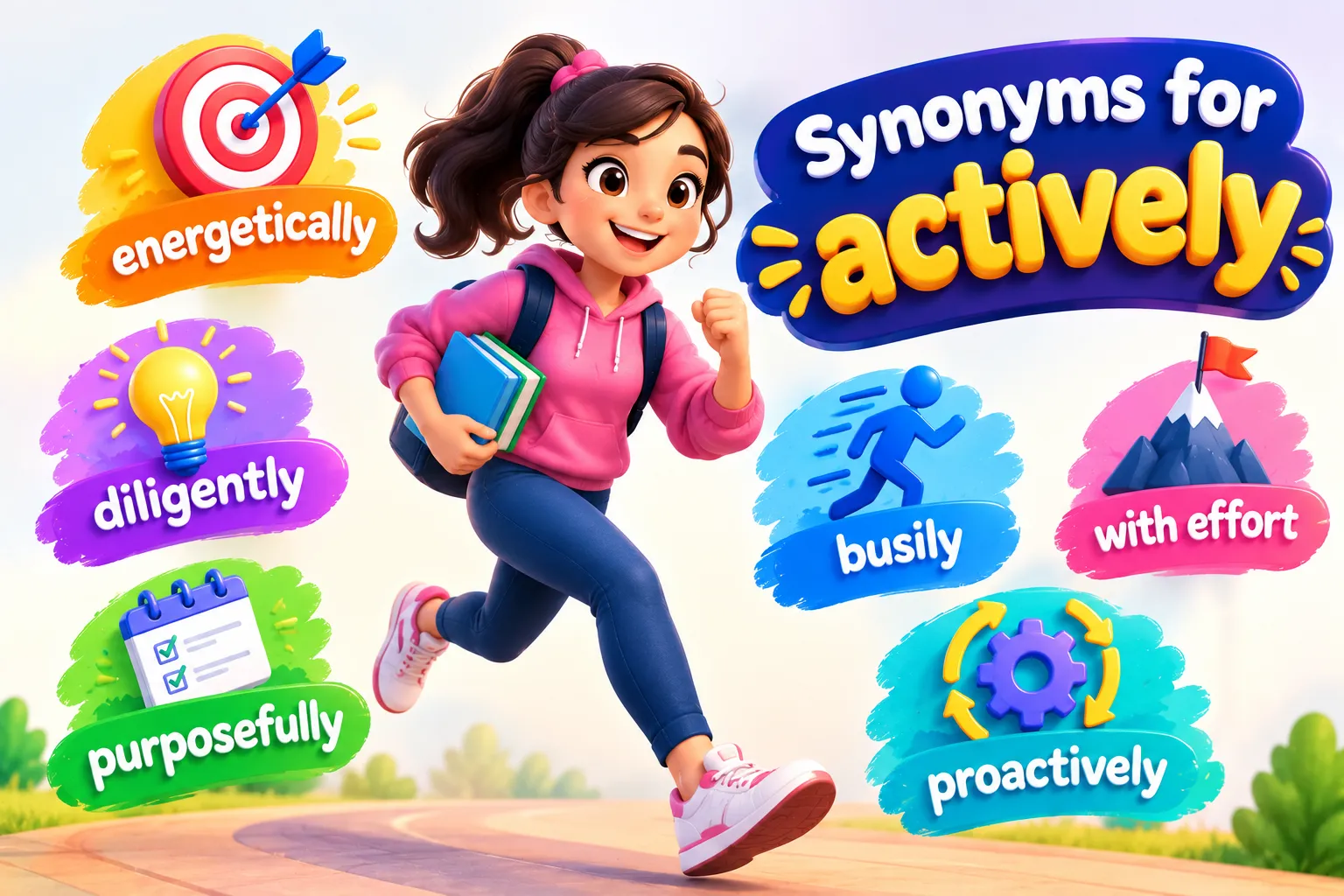
Common synonyms include energetically, enthusiastically, vigorously, eagerly, directly, intentionally, purposefully, diligently, proactively, and dynamically. The best alternative depends on the context. For example, actively participating means taking part directly, while actively seeking means making a strong effort to find something. Learning these alternatives helps English learners and writers express action and effort clearly without repeating the same word.
Actively means doing something with clear effort, energy, or involvement. Imagine a student in class who does more than simply listen. The student asks questions, joins discussions, takes notes, and helps classmates. We can say that the student actively participates in the lesson. The word is common in education, business, sports, communication, and everyday English because it shows that someone is taking action. Learning synonyms for actively gives English learners more ways to describe effort, participation, movement, and involvement. It also helps writers avoid repeating the same adverb. In this guide, we explore the meaning of actively, its examples, connotations, etymology, pronunciation, word formation, synonyms, antonyms, and semantic categories to help you use the word with confidence.
Meaning of Actively
Definition
Actively (Adverb):
Actively means doing something with effort, energy, direct involvement, or purpose.
Examples
- She actively participated in the class discussion.
- The company is actively looking for new employees.
Connotative Meaning
- Positive tone: Actively can suggest energy, effort, interest, and strong participation.
- Negative tone: In some contexts, it can suggest aggressive or unwanted involvement, such as actively interfering.
- Neutral tone: It can simply describe direct or ongoing action.
(Connotation means the feeling or idea that a word suggests beyond its basic meaning.)
Etymology
Actively comes from the adjective active, which comes from Latin activus, meaning “pertaining to action.” It is formed by adding the adverb suffix -ly to active.
| Period | Development |
| Old English (450–1100) | The modern word active was not directly present in Old English. English used native words related to doing, working, and acting. |
| Middle English (1100–1500) | Active entered English through Old French from Latin activus, meaning “pertaining to action.” |
| Modern English (1500–Present) | Active developed broad meanings related to action, participation, movement, and engagement. Actively became the adverb meaning “in an active way” or “with action and effort.” |
Pronunciation (IPA)
- IPA: /ˈæktɪvli/
- Syllables: ac-tive-ly
Affixation Pattern of Actively
- Root: act — from Latin agere, meaning “to do” or “to drive.”
- Prefix: None.
- Suffix: -ive forms the adjective active, and -ly forms the adverb actively.
- Word formations:
- act — verb/noun
- action — noun
- active — adjective
- actively — adverb
- activity — noun
- activate — verb
- activation — noun
- activist — noun
- activism — noun
- inactive — adjective
- inactively — adverb
- reactivate — verb
29 Synonyms of Actively With Meaning & Examples
Note: Some words below are close alternatives rather than exact synonyms. The best choice depends on the sentence and the type of action being described.
1. Energetically (Adverb)
Meaning: Energetically means doing something with a lot of energy and effort.
Examples:
- She worked energetically on the project.
- The children played energetically outside.
2. Enthusiastically (Adverb)
Meaning: Enthusiastically means doing something with strong interest and excitement.
Examples:
- The students enthusiastically joined the activity.
- He enthusiastically supported the new idea.
3. Vigorously (Adverb)
Meaning: Vigorously means doing something with great strength or energy.
Examples:
- The team vigorously defended its position.
- She vigorously cleaned the room.
4. Eagerly (Adverb)
Meaning: Eagerly means doing something with strong interest or excitement.
Examples:
- The students eagerly answered the questions.
- He eagerly accepted the opportunity.
5. Proactively (Adverb)
Meaning: Proactively means taking action before a problem or need requires it.
Examples:
- The manager proactively solved the issue.
- We should proactively prepare for possible problems.
6. Diligently (Adverb)
Meaning: Diligently means working carefully and steadily with great effort.
Examples:
- She studied diligently for her exam.
- He worked diligently to finish the report.
7. Purposefully (Adverb)
Meaning: Purposefully means doing something with a clear goal or intention.
Examples:
- She walked purposefully toward the office.
- He acted purposefully to solve the problem.
8. Intentionally (Adverb)
Meaning: Intentionally means doing something deliberately and with a clear purpose.
Examples:
- She intentionally chose a simple design.
- He intentionally avoided the topic.
9. Directly (Adverb)
Meaning: Directly means doing something in a clear and immediate way.
Examples:
- She directly contacted the manager.
- He directly addressed the problem.
10. Diligently (Adverb)
Meaning: Diligently means putting careful and continuous effort into an activity.
Examples:
- The researcher worked diligently on the study.
- They prepared diligently for the competition.
11. Continuously (Adverb)
Meaning: Continuously means doing something without stopping or with little interruption.
Examples:
- The machine operates continuously.
- She continuously worked to improve her skills.
12. Constantly (Adverb)
Meaning: Constantly means doing something very often or without much interruption.
Examples:
- He is constantly learning new skills.
- The team constantly monitors the system.
13. Deliberately (Adverb)
Meaning: Deliberately means doing something after making a conscious choice.
Examples:
- She deliberately changed her approach.
- He deliberately included more examples.
14. Forcefully (Adverb)
Meaning: Forcefully means doing or expressing something with strong power or emphasis.
Examples:
- The speaker forcefully explained his opinion.
- She forcefully pushed the door open.
15. Vigorous (Adjective)
Meaning: Vigorous describes action that uses strong energy or effort.
Examples:
- The team made a vigorous effort.
- He began a vigorous training program.
16. Wholeheartedly (Adverb)
Meaning: Wholeheartedly means doing something with complete support or sincere effort.
Examples:
- She wholeheartedly supported the plan.
- He wholeheartedly accepted the challenge.
17. Seriously (Adverb)
Meaning: Seriously means giving something careful attention or treating it as important.
Examples:
- She seriously considered the offer.
- He seriously worked toward his goal.
18. Attentively (Adverb)
Meaning: Attentively means giving careful attention to something.
Examples:
- The students listened attentively.
- She watched the demonstration attentively.
19. Busily (Adverb)
Meaning: Busily means being actively occupied with work or tasks.
Examples:
- The staff worked busily before the event.
- She was busily preparing dinner.
20. Industriously (Adverb)
Meaning: Industriously means working hard and steadily.
Examples:
- He worked industriously on the assignment.
- The workers industriously completed the task.
21. Assiduously (Adverb)
Meaning: Assiduously means working with great care, effort, and persistence.
Examples:
- She studied assiduously for the test.
- He assiduously developed his new skills.
22. Intensely (Adverb)
Meaning: Intensely means doing or experiencing something with great strength or concentration.
Examples:
- The students intensely focused on the task.
- She intensely studied the subject.
23. Effectively (Adverb)
Meaning: Effectively means doing something in a way that produces the desired result.
Examples:
- The team effectively solved the problem.
- She effectively communicated her ideas.
24. Engagedly (Adverb)
Meaning: Engagedly means with active interest, attention, or involvement.
Examples:
- The students listened engagedly to the speaker.
- The audience watched engagedly throughout the presentation.
25. Involvedly (Adverb)
Meaning: Involvedly means with active participation or personal involvement, though it is uncommon in everyday English.
Examples:
- She worked involvedly with the community.
- He participated involvedly in the discussion.
26. Dynamically (Adverb)
Meaning: Dynamically means in an energetic, changing, or active way.
Examples:
- The team worked dynamically together.
- The market is changing dynamically.
27. Promptly (Adverb)
Meaning: Promptly means doing something quickly or without delay.
Examples:
- She promptly responded to the email.
- The manager promptly addressed the complaint.
28. Readily (Adverb)
Meaning: Readily means doing something willingly or without difficulty.
Examples:
- He readily accepted the task.
- She readily joined the discussion.
29. Deliberately (Adverb)
Meaning: Deliberately means doing something consciously and with intention.
Examples:
- He deliberately practiced the skill every day.
- She deliberately chose words that were easy to understand.
Prototype Meaning
The most typical meaning of actively is doing something with direct effort or involvement. When people hear this word, they often imagine someone taking action rather than sitting back and waiting. For example, an actively involved student asks questions, joins activities, and takes part in learning. The word can describe physical action, mental effort, participation, searching, or intentional behavior.
Prototype Categorization
The 29 alternatives can be grouped into useful semantic categories:
- Energy and effort: energetically, vigorously, busily, industriously, assiduously, intensely. These words emphasize hard work, strength, or high energy.
- Interest and enthusiasm: enthusiastically, eagerly, wholeheartedly, attentively, readily. These work well when someone shows interest or willingness.
- Purpose and intention: purposefully, intentionally, deliberately, proactively. These describe action that is planned or done for a clear reason.
- Direct participation: directly, engagedly, involvedly, dynamically, assertively. These emphasize active involvement or clear action.
- Speed and response: promptly, readily, continuously, constantly. These can describe quick, regular, or ongoing action.
- Results and effectiveness: effectively, seriously, forcefully. These focus on strong action or the quality and impact of the action.
This categorization helps writers select a more precise alternative. For example, use proactively when someone acts before a problem occurs, but use enthusiastically when someone acts with excitement and interest.
Antonyms of Actively
| Antonym | Part of Speech | Meaning |
| Passively | Adverb | Without taking direct action or control. |
| Inactively | Adverb | Without activity or action. |
| Idly | Adverb | Without doing useful or purposeful work. |
| Inertly | Adverb | In a way that shows little or no movement or action. |
| Reluctantly | Adverb | Doing something without willingness or enthusiasm. |
| Unwillingly | Adverb | Doing something without wanting to do it. |
| Indifferently | Adverb | Without much interest or concern. |
| Casually | Adverb | Without serious effort or strong attention. |
| Lazily | Adverb | Without much effort or energy. |
| Inactively | Adverb | In a state of doing little or nothing. |
Short Questions and Answers
What does actively mean?
Actively means doing something with effort, energy, direct involvement, or purpose.
When should actively be used?
Use actively when you want to show that someone is taking action, participating, searching, working, or making a deliberate effort.
Is actively positive or negative?
Actively is usually neutral or positive. It often suggests effort and participation, but the context can make it negative, such as actively causing problems.
How is actively different from similar words?
Actively is a broad word for direct action or involvement. Energetically focuses on energy, enthusiastically focuses on excitement, and proactively focuses on taking action before a problem occurs.
Conclusion
Learning actively and its synonyms can make your English more precise and flexible. Words such as energetically, enthusiastically, diligently, proactively, purposefully, intentionally, and attentively describe different types of action and effort. Choosing the right word helps you avoid repetition and makes your writing easier to understand. These alternatives are useful in schoolwork, business writing, conversations, reports, and everyday communication. English learners can improve their vocabulary by studying each word in a real sentence instead of memorizing isolated definitions. Try using one new synonym each day in your writing or speaking. Regular practice will help you understand small differences between similar words. Over time, this habit can strengthen your vocabulary, improve your communication skills, and build greater confidence in English.
Read More:
Synonyms for Self Love: 25 Powerful Words for Confidence

I am Rubab content specialist focused on creating accurate, user-friendly, and search-optimized language resources. Through Synonyminstant, I help readers find synonyms, antonyms, meanings, and vocabulary with ease. Every article is carefully researched and optimized to provide reliable information, clear explanations, and an excellent user experience.