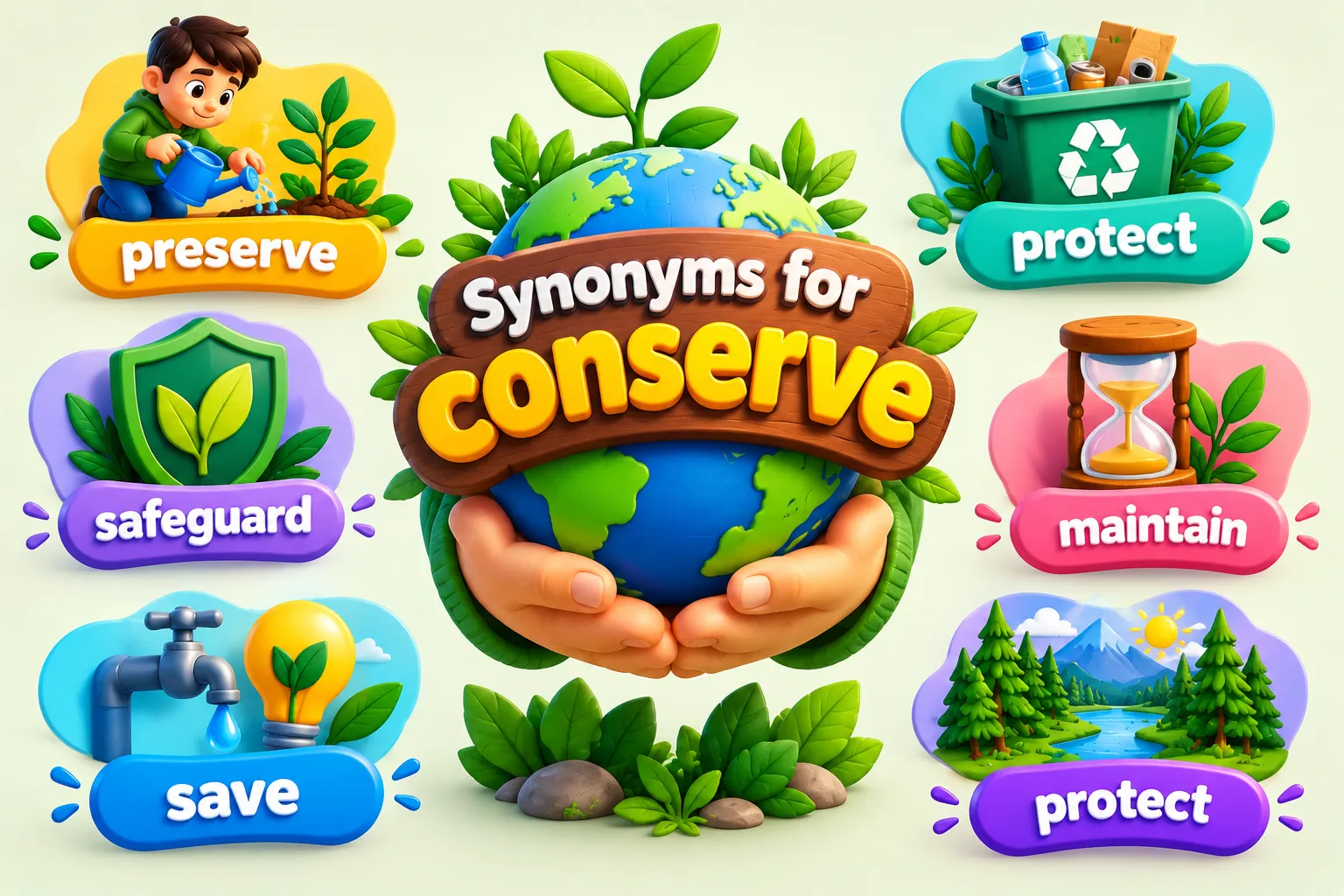
Common synonyms include preserve, save, protect, maintain, safeguard, store, retain, spare, sustain, economize, and husband. The best synonym depends on the context because conserving water is different from conserving an old building or conserving energy.
Conserve means to use something carefully and protect it from waste or loss. For example, a family may conserve water by turning off the tap while brushing their teeth. A community may conserve forests to protect wildlife and natural resources. The word is common in discussions about the environment, money, energy, food, and valuable resources. Learning synonyms for conserve helps English learners express the idea of saving and protecting things in different ways. It also helps content writers avoid repetition and choose more precise vocabulary. Some synonyms focus on saving, while others emphasize protection, preservation, careful use, or continued supply. In this article, we will explore the meaning, examples, pronunciation, history, word formation, and 27 useful synonyms of conserve. We will also study semantic groups, antonyms, and common usage.
Meaning of Conserve
Definition
Conserve (Verb):
To protect something from waste, damage, loss, or unnecessary use so it can remain available or useful.
Examples
- We should conserve water during the dry season.
- Turning off unused lights can help conserve energy.
Connotative Meaning
- Positive tone: Care, responsibility, protection, sustainability, and wise use.
- Negative tone: It can sometimes suggest restriction or limiting the use of something.
- Neutral tone: Simply keeping something safe or using it carefully.
(Connotation means the feeling or idea that a word suggests beyond its basic meaning.)
Etymology
The word conserve comes from Latin conservare, meaning “to preserve” or “to keep safe.” It entered English through Old French and developed into both a verb and noun.
| English Period | Development |
| Old English (450–1100) | The modern form conserve was not established in Old English. Ideas of keeping, guarding, and preserving were expressed through native Germanic words. |
| Middle English (1100–1500) | Conserve entered English through Old French, from Latin conservare, meaning “to keep safe” or “preserve.” |
| Modern English (1500–Present) | Conserve developed its modern meanings of protecting resources, avoiding waste, and preserving something for future use. |
Pronunciation (IPA)
- IPA: /kənˈsɜːrv/
- Syllables: con-serve
Affixation Pattern of Conserve
- Root: serv — from Latin servare, meaning “to keep” or “to preserve.”
- Prefix: con- — meaning “together” or contributing to the idea of keeping something intact.
- Suffix: None in the basic verb conserve.
- Word formations:
- Conserve (verb): to protect or use carefully.
- Conservation (noun): the protection or careful management of something.
- Conservative (adjective/noun): favoring preservation or limited change; also a person with conservative views.
- Conservatively (adverb): in a cautious or restrained way.
- Conservator (noun): a person who protects or manages something valuable.
- Conservancy (noun): an organization or system for protecting natural resources.
- Conserved (adjective/verb): protected or saved from waste.
27 Synonyms of Conserve With Meaning & Examples
1. Preserve (Verb)
Meaning: To keep something safe, protected, or in its original condition.
Examples:
- We must preserve historic buildings.
- The museum works to preserve old paintings.
2. Save (Verb)
Meaning: To keep something from being wasted, lost, or used unnecessarily.
Examples:
- Please save water whenever possible.
- We can save energy by turning off the lights.
3. Protect (Verb)
Meaning: To keep someone or something safe from harm or damage.
Examples:
- Laws help protect endangered animals.
- We should protect our forests.
4. Safeguard (Verb)
Meaning: To protect something carefully from harm or loss.
Examples:
- The program helps safeguard natural resources.
- Strong rules safeguard the environment.
5. Maintain (Verb)
Meaning: To keep something in good condition or at a particular level.
Examples:
- Regular care helps maintain the building.
- We need to maintain clean water supplies.
6. Retain (Verb)
Meaning: To continue to keep or hold something.
Examples:
- The soil can retain water.
- The company wants to retain its best workers.
7. Spare (Verb)
Meaning: To avoid using, harming, or wasting something.
Examples:
- We should spare natural resources whenever possible.
- Try to spare some food for tomorrow.
8. Sustain (Verb)
Meaning: To keep something going or support it over a long period.
Examples:
- Solar power can sustain energy needs.
- Good farming practices help sustain the land.
9. Economize (Verb)
Meaning: To use money or resources carefully and avoid waste.
Examples:
- We need to economize on electricity.
- The family learned to economize during difficult times.
10. Husband (Verb)
Meaning: To use a resource carefully and avoid wasting it.
Examples:
- Farmers must husband their water supplies.
- We should husband our limited resources.
11. Store (Verb)
Meaning: To keep something in a safe place for future use.
Examples:
- We store rainwater for dry months.
- The system can store extra energy.
12. Reserve (Verb)
Meaning: To keep something available for future use.
Examples:
- The town reserves water for emergencies.
- We should reserve some resources for future generations.
13. Keep (Verb)
Meaning: To continue having or holding something instead of losing or using it.
Examples:
- Keep some water for later.
- The box helps keep food fresh.
14. Hoard (Verb)
Meaning: To collect and keep large amounts of something instead of using or sharing it.
Examples:
- Some people hoard food during emergencies.
- He tends to hoard old supplies.
Note: Hoard usually has a negative meaning and is not a good synonym for responsible conservation.
15. Manage (Verb)
Meaning: To control and use resources in a careful or effective way.
Examples:
- We must manage water supplies wisely.
- The team managed its resources carefully.
16. Utilize Carefully (Verb Phrase)
Meaning: To use something in a careful way that reduces waste.
Examples:
- We should utilize natural resources carefully.
- The company tries to utilize energy carefully.
17. Reduce Waste (Verb Phrase)
Meaning: To use resources in a way that creates less unnecessary waste.
Examples:
- Recycling helps reduce waste.
- Families can reduce waste by reusing containers.
18. Recycle (Verb)
Meaning: To process used materials so they can be used again.
Examples:
- We recycle plastic bottles.
- The city encourages people to recycle paper.
19. Reuse (Verb)
Meaning: To use something again instead of throwing it away.
Examples:
- We can reuse glass containers.
- Reuse shopping bags to reduce waste.
20. Preserve (Verb)
Meaning: To keep something from being damaged, changed, or lost.
Examples:
- The project aims to preserve wildlife.
- We should preserve local traditions.
21. Maintain (Verb)
Meaning: To keep something at a desired level or condition.
Examples:
- The system helps maintain water quality.
- Farmers work to maintain healthy soil.
22. Conserve Energy (Verb Phrase)
Meaning: To reduce unnecessary energy use.
Examples:
- Turn off fans to conserve energy.
- New appliances can help families conserve energy.
23. Protect Resources (Verb Phrase)
Meaning: To prevent valuable resources from being damaged or wasted.
Examples:
- We must protect resources for future generations.
- New policies can protect resources from overuse.
24. Limit Use (Verb Phrase)
Meaning: To control how much of something is used.
Examples:
- We should limit the use of plastic.
- The city decided to limit water use.
25. Cut Back (Phrasal Verb)
Meaning: To reduce the amount of something used or spent.
Examples:
- We need to cut back on electricity use.
- She cut back on unnecessary spending.
26. Economize On (Phrasal Verb)
Meaning: To use less of something to avoid waste or save money.
Examples:
- We should economize on fuel.
- The company is trying to economize on office supplies.
27. Guard (Verb)
Meaning: To protect something from harm, loss, or misuse.
Examples:
- Rangers guard the protected forest.
- Strong laws guard natural resources.
Prototype Meaning
The most typical meaning of conserve is to protect something valuable by using it carefully and avoiding waste. When people hear this word, they often think about saving water, electricity, forests, wildlife, fuel, or other natural resources. For example, turning off a tap, using less electricity, or protecting a forest are all common examples of conservation.
Prototype Categorization
- Saving and keeping: save, keep, retain, reserve, store — useful when the focus is on keeping something for later.
- Protection: protect, safeguard, guard, preserve — best when the main idea is preventing harm or loss.
- Careful resource use: economize, husband, manage, cut back — useful when resources must be used wisely.
- Environmental conservation: preserve, recycle, reuse, protect resources — common in environmental writing.
- Long-term support: sustain, maintain — useful when something needs to continue or remain at a healthy level.
- Reducing waste: reduce waste, reuse, recycle, limit use — useful when the goal is to reduce unnecessary consumption.
These categories help writers select the most precise alternative based on whether they mean saving, protecting, reducing use, or supporting something over time.
Antonyms of Conserve
| Antonym | Part of Speech | Meaning |
| Waste | Verb | To use something carelessly or unnecessarily. |
| Squander | Verb | To waste something valuable through careless use. |
| Consume | Verb | To use something up. |
| Exhaust | Verb | To use all of something until none remains. |
| Destroy | Verb | To damage something so it no longer exists or works. |
| Deplete | Verb | To reduce a supply greatly or use most of it. |
| Discard | Verb | To throw something away or stop using it. |
| Abuse | Verb | To use something in a harmful or improper way. |
| Overuse | Verb | To use something too much. |
| Neglect | Verb | To fail to care for or protect something properly. |
Short Questions and Answers
What does conserve mean?
Conserve means to protect something from waste or loss and use it carefully so it remains available.
When should conserve be used?
Use conserve when talking about saving or protecting resources such as water, energy, money, food, forests, wildlife, and fuel.
Is conserving positive or negative?
Conserve usually has a positive meaning because it suggests responsibility, careful use, and protection.
How is it different from similar words?
Conserve means to save and use something wisely. Preserve focuses more on keeping something safe or unchanged, while protect focuses on preventing harm. Save is broader and can mean simply keeping something from being lost or wasted.
Conclusion
Learning conserve and its synonyms can make your English more accurate and flexible. Words such as preserve, save, protect, safeguard, maintain, retain, sustain, and economize all connect with the idea of careful use or protection, but they are not always interchangeable. Choosing the right word helps you express your exact meaning in essays, articles, conversations, and professional writing. Understanding these differences also improves your vocabulary and reduces repetition. English learners can practice by creating simple sentences about water, energy, money, food, and natural resources. Content writers can use these alternatives to make environmental and educational topics more engaging. Try learning a few words each day and using them in real sentences. Regular practice will strengthen your writing, speaking, and confidence in English.
Read More:
Synonyms for uneasy: 25 Powerful Alternatives

I’m Pinki, an SEO writer at SynonymsInstant.com, specializing in synonyms, antonyms, vocabulary, word meanings, grammar, and English usage. I create accurate, well-researched, reader-friendly content that combines language expertise with SEO best practices. My goal is to make English vocabulary simple, useful, and accessible for students, writers, professionals, and English learners.